Affichage des articles dont le libellé est French Art. Afficher tous les articles

vendredi 4 avril 2014

Jules Cheret Palais de Glace Champs Elysées


Jules Cheret Palais de Glace Champs Elysées

Artist:
Jules Chéret (1836 – 1932) was a French painter and lithographer who became a master of Belle Époque poster art. He has been called the father of the modern poster.
As his work became more popular and his large posters displaying modestly free-spirited females found a larger audience, pundits began calling him the "father of the women's liberation." Females had previously been depicted in art as prostitutes or puritans. The women of Chéret's posters, joyous, elegant and lively—'Cherettes', as they were popularly called—were neither. It was freeing for the women of Paris, and heralded a noticeably more open atmosphere in Paris where women were able to engage in formerly taboo activities, such as wearing low-cut bodices and smoking in public. These 'Cherettes' were widely seen and recognised, and a writer of the time said "It is difficult to conceive of Paris without its 'Cheréts'.

Advertising:
"Palais de Glace - Champs Elysées" : "Ice's Palace - Champs Elysees"

Available here

samedi 1 mars 2014

Alfons Mucha - Biscuits Champagne Lefevre-Utile LU

Alphonse Mucha - Biscuits Lefèvre-Utile

1896
Lefèvre-Utile, a Nantes-based manufacturer of biscuits, commissioned top artists to do their publicity. In addition to posters, Mucha also designed box tops, wrappers and other printed matter for the company.
The social setting depicted in this poster is intended to show Lefèvre-Utile products to be consumed in high society.

Alphonse Mucha
Artist:
ALPHONSE MUCHA (1860 – 1939), was a Czech Art Nouveau painter and decorative artist, known best for his distinct style. He produced many paintings, illustrations, advertisements, postcards, and designs. His Art Nouveau style was often imitated. The Art Nouveau style however, was one that Mucha attempted to disassociate himself from throughout his life; he always insisted that rather than maintaining any fashionable stylistic form, his paintings were entirely a product of himself and Czech art.


Biscuits LU
Advertising:
LEFEVRE UTILE, better known worldwide by the initials LU, is a manufacturer brand of French biscuits, emblematic of the city of Nantes.
Lefèvre-Utile was founded in Nantes, France, in 1846 by Jean-Romain Lefèvre. Originally he sold biscuits from the English factory Huntley & Palmers and then he began his own production. The name LU comes from Lefèvre and his business partner and wife, Pauline-Isabelle Utile. Their initials were first utilized by Alfons Mucha for an 1897 calendar ad for the Lefèvre-Utile Biscuit Co. That same year the company hired Firmin Bouisset to create a poster ad. Bouisset, already noted for his work for the Menier Chocolate company, created Petit Écolier ("the Little Schoolboy") which incorporated the LU initials. Bouisset's poster was used extensively and the image was embossed on the company's Petit Beurre line of biscuits. Within a few years, the success of the logo resulted in the company becoming known as LU.

Available here

samedi 15 février 2014

Salon des 100 by Paul Emile Berthon - Art Nouveau French poster

https://www.etsy.com/listing/123426664/french-advertisement-poster-for-the?ref=shop_home_active_8

Artist:
Paul Émile Berthon (1872–1909) was a French artist who produced primarily posters and lithographs. Berthon's work is in the style of Art Nouveau, much like his contemporary Alphonse Mucha. Berthon studied as a painter in Villefranche before moving to Paris. He later enrolled at the Ecole Normale d'Enseignement de Dessin and received lessons from Luc-Olivier Merson. His study of the decorative arts influenced his print making, influencing the strong lines and natural details that guided his art. The vast majority of Berthon's lithographed posters did not include advertisements and were meant to stand on their own.

Advertising:
Salon des Cent ("Salon of the One Hundred") was a commercial art exhibition in Paris, based at 31 Rue Bonaparte. The Salon sold color posters, prints and reproductions of artwork to the general public at reasonable prices. It was established in February 1894 by Léon Deschamps, founder of La Plume ("The Pen") an avant garde literary and artistic magazine. It became known for its exhibitions showcasing the works of contemporary graphical artists. The salon held exhibitions until 1900. Many of the posters advertising Salon des Cent exhibitions have themselves become collectors' items.

Available here

jeudi 30 janvier 2014

Alfons Mucha - Times of the Day

Alfons Mucha Morning Awakening - Brightness of Day - Evening Contemplation - Night's Rest
Morning Awakening - Brightness of Day - Evening Contemplation - Night's Rest


Alphonse Mucha (1860 – 1939), was a Czech Art Nouveau painter and decorative artist, known best for his distinct style. He produced many paintings, illustrations, advertisements, postcards, and designs. His Art Nouveau style was often imitated. The Art Nouveau style however, was one that Mucha attempted to disassociate himself from throughout his life; he always insisted that rather than maintaining any fashionable stylistic form, his paintings were entirely a product of himself and Czech art.

In this serie, "the Times of the Day" (1899), Mucha combined fresh yet delicate colours with exuberant floral motifs. Each woman is set within natural surroundings which reflects her mood. The whole is then enclosed in an elaborate ornamental frame reminiscent of a Gothic window.

Available here


vendredi 17 janvier 2014

Josephine Baker by Paul Colin


PAUL COLIN (27 June 1892 in Nancy, France - 18 June 1985 in Nogent-sur-Marne) was one of France’s greatest poster artists.
Made famous in 1925 by his poster for the Revue Nègre, which helped to launch the career of Josephine Baker (who became his mistress), he worked for over forty years in the theatre, creating not only posters but also numerous sets and costumes.
Very Art déco at the outset, (his Le Tumulte noir is a masterpiece of the genre), his style quickly became highly personal and impossible to categorize: the synthetic accuracy of his portraits, the evocative force of his posters for grand causes so marked him as a master of visual communication that his work today remains relevant and fresh. A student of Eugène Vallin and of Victor Prouvé, he is considered a master of the modern school of poster art. He is the author of over 1400 posters and many theatrical set and costume designs.


JOSEPHINE BAKER (1906 – 1975) was an American-born French dancer, singer, and actress. Born Freda Josephine McDonald in St. Louis, Missouri, she became a citizen of France in 1937. Fluent in both English and French, Baker became an international musical and political icon. She was given such nicknames as the "Bronze Venus", the "Black Pearl", and the "Créole Goddess".
Baker was the first African American female to star in a major motion picture, Zouzou, to integrate an American concert hall, and to become a world-famous entertainer. She is also noted for her contributions to the Civil Rights Movement in the United States (she was offered the unofficial leadership of the movement by Coretta Scott King in 1968 following Martin Luther King, Jr.'s assassination, but turned it down), for assisting the French Resistance during World War II, and for being the first American-born woman to receive the French military honor, the Croix de guerre.


Available here

mercredi 15 janvier 2014

Soir de Paris - Bourjois poster

This "Bourjois" poster is one of my absolute favorite !
The image is so romantic: the man and the woman about to kiss, the Eiffel Tower on the background, the sunset colors, everything !
There are two others posters by the same artist, Pierre-Laurent Brenot, advertising the Bourjois perfume.
Available here.


Pierre-Laurent Brenot (8 July 1913 – 8 May 1998), was a French painter who also had a great activity in fashion and advertising. He is also known as the father of the "French pin-up".


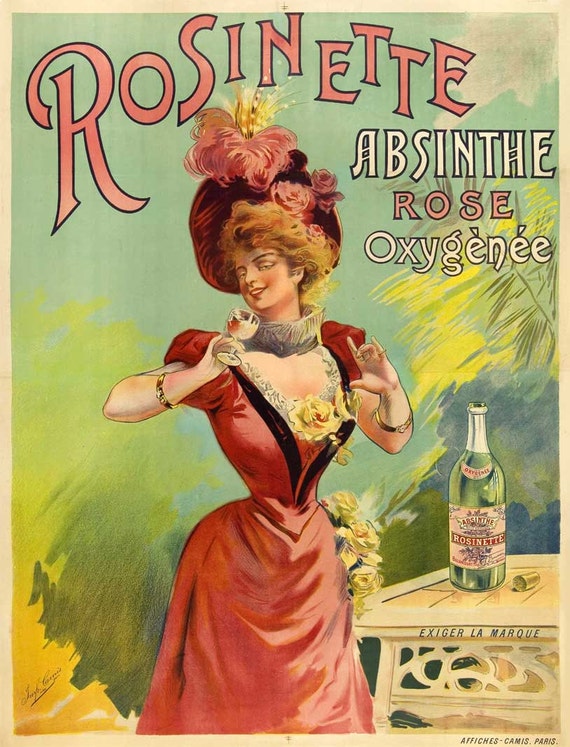
Rosinette Absinthe rose


Artist: unknown

Advertising: Rosinette, Absinthe Rosé Oxygénée

Era: 1890s

An unrecorded lithographic poster for Rosinette, Absinthe Rosé Oxygénée, printed by Camis around 1900. This is the only know historical reference to a rosé absinthe. 
Absinthe is historically described as a distilled, highly alcoholic beverage and is commonly referred to in historical literature as "la fée verte" (the green fairy). Absinthe arose to great popularity as an alcoholic drink in late 19th- and early 20th-century France, particularly among Parisian artists and writers. Owing in part to its association with bohemian culture, the consumption of absinthe was opposed by social conservatives and prohibitionists.

Available here

Leonetto Cappiello : Je ne fume que le Nil

Artist: Leonetto Cappiello

Advertising: Le Nil - cigarette paper company

Era: 1910s

Leonetto Cappiello (1875 – 1942) was an Italian poster art designer who lived in Paris. He is now often called 'the father of modern advertising' because of his innovation in poster design. The early advertising poster was characterized by a painterly quality as evidenced by early poster artists Jules Chéret, Alfred Choubrac and Hugo D'Alesi. Cappiello, like other young artists, worked in way that was almost the opposite of his predecessors. He was the first poster artist to use bold figures popping out of black backgrounds, a startling contrast to the posters early norm.
This poster, created around 1900-1910, is an advertisement for the "papier à cigarettes" (cigarette rolling paper). The elephant is an exotic symbol of Africa and Egypt, the country of the Nil river. Exotic symbols were very used during the colonial times of the Belle Epoque.

Available here

BYRRH Advertisement

I've just found more than 50 Byrrh advertisements by Georges Léonnec ! I do not know if they are famous in the USA but they are in France.
They are already available in my Etsy shop: http://etsy.me/1brmNgc

Byrrh is a wine-based apéritif made of red wine, mistelle, and quinine. Created in 1866, it was popular as a French apéritif. With its marketing and reputation as a "hygienic drink", Byrrh sold well in the early 20th century. In the 1930s, Byrrh had 50% of the "aperitif" market share in France.

BYRRH Factory
The Story:
Brothers Pallade and Simon Violet, itinerant drapers, decided to take advantage of the wine fever in the region to develop an apéritif wine flavored with cinchona. They mixed dry wines and mistelles and initially marketed the resulting product as a health drink or tonic. This was because the local apéritif producers were displeased about competition with their established brands. Rebranding the brothers' aperitif as a health drink got around this problem, and Byrrh was sold in pharmacies.


The Second World War initiated the decline of Byrrh. Aided by tax benefits, natural sweet wines such as Banyuls, Muscat de Frontignan, and Rivesaltes superseded Byrrh, which went out of fashion.

In 1977, the family business, divided by strife, was acquired by Pernod-Ricard. Pernod-Ricard still makes the drink at its facility in Thuir near Perpignan, part of which was designed by Gustave Eiffel.

Advertisements for Byrrh are often visible in older French films or in films set in the France of the past. One example is François Truffaut's Shoot the Piano Player (1960), or the 1970 World War II comedy Kelly's Heroes.

Mad Men Season 4, episode 6 ("Waldorf Stories") featured a Byrhh advertisement that won a CLIO Award in April 1965. AV Club Reviewer Keith Phipps notes: "One of the other Clios went to Byrrh, a wine-based aperitif whose failure to catch fire in America illustrates that even great advertising can’t sell something people don’t want."
BYRRH in Mad Men

The most famous Byrrh advertisements were created by Georges Léonnec.

Georges Léonnec (1881 – 1940), the brother of the novelist Félix Léonnec, began his career as a cartoonist selling drawings to newspapers in 1899. After participating in World War I he worked as an illustrator for the magazine La Vie Parisienne. He worked for several other publications including Fantasio and Le Sourire. He was also well known for his advertising illustrations for Byrrh apéritif wine, Dufayel department stores, and the Casino of Paris.

This is just a few of the ads available in the shop: http://etsy.me/1brmNgc
The ads are true vintage ads from the 30s, not recent reprint !