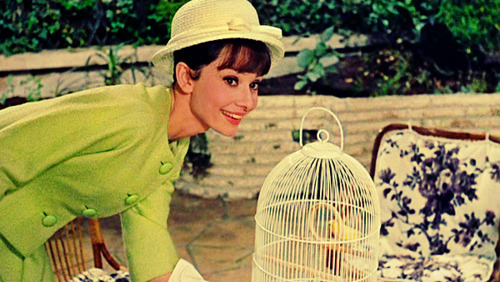
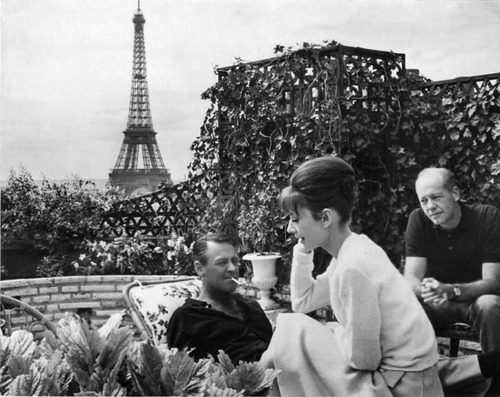
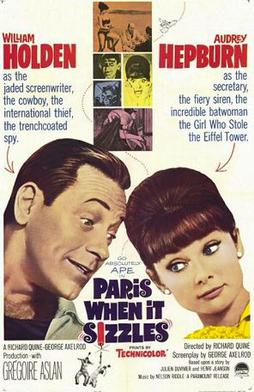
Last week I found an old 1964 romantic comedy film: "Paris When It Sizzles". Directed by Richard Quine. The film stars William Holden and Audrey Hepburn, and features Grégoire Aslan, Raymond Bussières and Noël Coward. and Tony Curtis.
The screenplay is by George Axelrod based on the story and film Holiday for Henrietta (La fête à Henriette) a 1952 French movie by Julien Duvivier and Henri Jeanson.
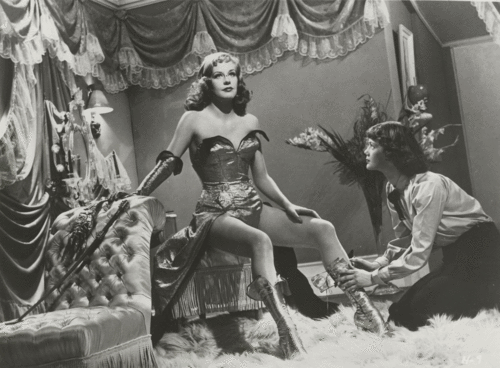
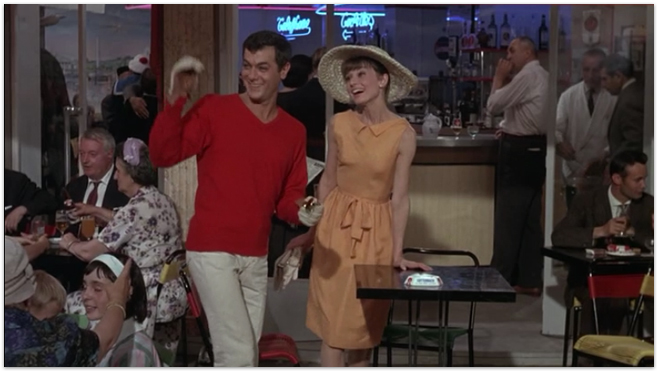
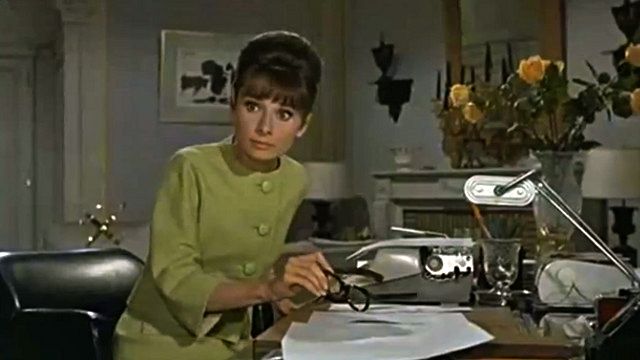
The story concerns a veteran playboy screenwriter named Richard Benson (William Holden) who has been paid to write a screenplay for his boss, Mr. Alexander Myerheim (Noël Coward). Overly set in his playboy and carousing ways, he procrastinates the writing of the screenplay until just two days before it is due. Gabrielle Simpson (Audrey Hepburn), a temp secretary hired by Benson to type the script, comes to Richard's hotel room where they are to work on the script, only then finding out about their tight deadline and that not one page or line of script had yet been written. The desperate and self-loathing writer, Richard, begins to be awakened and inspired by the beautiful Gabrielle, and starts to come up with various scenarios for his screenplay, called The Girl Who Stole the Eiffel Tower, which is based on their unfolding romance. The screenplay, with small but inspired and comedic roles for Noël Coward, Tony Curtis, and other famous stars of the day, makes fun of the movie business, actors, studio heads and itself, and is rife with allusions to the iconic earlier roles of the two main stars.
This is the 2nd post about Paris seen by American movies!
If you love Paris and specially Paris during the Roaring Twenties and the Belle Epoque. You definitively want to see this one !
I
do not want to give you too many informations about the movie, because
it might spoil you the surprise. But I still want to introduce you some
of the characters. (If you don't want to know, do not read! ;) )
In this movie you'll meet several American writers and artists from the 20s, living in Paris at that time:
Zelda and F.Scott Fitzgerald
(by Alison Pill and Tom Hiddleston). F.Scott is an American author of
novels and short stories, whose works are the paradigmatic writings of
the Jazz Age. He is widely regarded as one of the greatest American
writers of the 20th century. (by the way, he's the one who wrote "The
Great Gatsby"!)
Ernest Hemingway
(by Corey Stoll) was an American author and journalist. His economical
and understated style had a strong influence on 20th century fiction,
while his life of adventure and his public image influenced later
generations. Hemingway produced most of his work between the mid-1920s
and the mid-1950s, and won the Nobel Prize in Literature in 1954. He
published seven novels, six short story collections, and two non-fiction
works. His most famous work is "The Old Man and the Sea".
In
1921 he married Hadley Richardson, the first of his four wives. The
couple moved to Paris, where he worked as a foreign correspondent, and
fell under the influence of the modernist writers and artists of the
1920s "Lost Generation" expatriate community.
Pablo Picasso (by Marcial dy Fonzo Bo) was a Spanish painter, sculptor, printmaker, ceramicist, and
stage
designer who spent most of his adult life in France. As one of the
greatest and most influential artists of the 20th century, he is widely
known for co-founding the Cubist movement, the invention of constructed
sculpture, the co-invention of collage, and for the wide variety of
styles that he helped develop and explore. Among his most famous works
are the proto-Cubist Les Demoiselles d'Avignon (1907), and Guernica
(1937), a portrayal of the German bombing of Guernica during the Spanish
Civil War.
Salvador Dalí
(by Adrien Brody) (his real name is Salvador Domingo Felipe Jacinto
Dalí i Domènech, 1st Marqués de Dalí de Pubol (!)). He was a prominent
Spanish
surrealist painter born in Figueres, in the Catalonia region of Spain.
Dalí was a skilled draftsman, best known for the striking and bizarre
images in his surrealist work. His painterly skills are often attributed
to the influence of Renaissance masters. His best-known work, The
Persistence of Memory, was completed in 1931. Dalí's expansive artistic
repertoire included film, sculpture, and photography, in collaboration
with a range of artists in a variety of media.
Henri de Toulouse-Lautrec (by Vincent Menjou Cortes) and Edgar Degas (by François Rostain). Henri de Toulouse-Lautrec (1864 – 1901) was a French painter, printmaker, draughtsman, and
illustrator, whose immersion in the colourful and theatrical life of
Paris in the late 1800s yielded a collection of exciting, elegant and
provocative images of the modern and sometimes decadent life of those
times. Toulouse-Lautrec is known along with Cézanne, Van Gogh, and
Gauguin as one of the greatest painters of the Post-Impressionist
period. Edgar Degas,
born Hilaire-Germain-Edgar De Gas; 19 July 1834 – 27 September 1917)
was a French artist famous for his paintings, sculptures, prints, and
drawings. He is especially identified with the subject of dance; more
than half of his works depict dancers. He is regarded as one of the
founders of Impressionism, although he rejected the term, and preferred
to be called a realist.
"The « Paris vu par Hollywood » (Paris seen by
Hollywood) exposition focuses on how American cinema has represented the
French capital for over one century. Paris is the foreign city represented the most
often in Hollywood cinema. Over the past century, an estimated eight
hundred American films have been located in Paris!
What clichés of the city does Hollywood
create? They are found in the opening shots of “An American in Paris”
(1951), Place de la Concorde, the Opera, the Alexandre III bridge with
the Eiffel Tower in the background, Place Vendome in front of the Ritz,
the Tuileries Garden…But why has Hollywood invested so much in shooting,
or rather creating, Paris in hundreds of films? For the American
public, Paris symbolises desire, pleasure and sophistication. These
films in Paris say as much about the French capital as they do about
American desire !"
It gave me the idea to share with you some american movies about France (and also french movies !)
I will start with Funny Face,
an American musical film released in 1957, with assorted songs by
George and Ira Gershwin. The film was written by Leonard Gershe and
directed by Stanley Donen.
The three characters Audrey
Hepburn, Fred Astaire, and Kay Thompson just arrived in Paris and start
singing "Bonjour, Paris" (good morning, Paris) while visiting the city.

 Last week I found an old 1964 romantic comedy film: "Paris When It Sizzles". Directed by Richard Quine. The film stars William Holden and Audrey Hepburn, and features Grégoire Aslan, Raymond Bussières and Noël Coward. and Tony Curtis.