vendredi 17 janvier 2014

Josephine Baker by Paul Colin


PAUL COLIN (27 June 1892 in Nancy, France - 18 June 1985 in Nogent-sur-Marne) was one of France’s greatest poster artists.
Made famous in 1925 by his poster for the Revue Nègre, which helped to launch the career of Josephine Baker (who became his mistress), he worked for over forty years in the theatre, creating not only posters but also numerous sets and costumes.
Very Art déco at the outset, (his Le Tumulte noir is a masterpiece of the genre), his style quickly became highly personal and impossible to categorize: the synthetic accuracy of his portraits, the evocative force of his posters for grand causes so marked him as a master of visual communication that his work today remains relevant and fresh. A student of Eugène Vallin and of Victor Prouvé, he is considered a master of the modern school of poster art. He is the author of over 1400 posters and many theatrical set and costume designs.


JOSEPHINE BAKER (1906 – 1975) was an American-born French dancer, singer, and actress. Born Freda Josephine McDonald in St. Louis, Missouri, she became a citizen of France in 1937. Fluent in both English and French, Baker became an international musical and political icon. She was given such nicknames as the "Bronze Venus", the "Black Pearl", and the "Créole Goddess".
Baker was the first African American female to star in a major motion picture, Zouzou, to integrate an American concert hall, and to become a world-famous entertainer. She is also noted for her contributions to the Civil Rights Movement in the United States (she was offered the unofficial leadership of the movement by Coretta Scott King in 1968 following Martin Luther King, Jr.'s assassination, but turned it down), for assisting the French Resistance during World War II, and for being the first American-born woman to receive the French military honor, the Croix de guerre.


Available here

mercredi 15 janvier 2014

Soir de Paris - Bourjois poster

This "Bourjois" poster is one of my absolute favorite !
The image is so romantic: the man and the woman about to kiss, the Eiffel Tower on the background, the sunset colors, everything !
There are two others posters by the same artist, Pierre-Laurent Brenot, advertising the Bourjois perfume.
Available here.


Pierre-Laurent Brenot (8 July 1913 – 8 May 1998), was a French painter who also had a great activity in fashion and advertising. He is also known as the father of the "French pin-up".


Your profile on a Mucha Poster ! 80% OFF

https://www.etsy.com/listing/174951320/custom-profile-silhouette-print-by?ref=shop_home_active_13 
https://www.etsy.com/listing/174963239/custom-silhouette-print-by-alfons-mucha?ref=shop_home_active_14Hey guys !

So excited about these two new posters !

I had the idea since a while. It took me a long time to find a way to create it.

Each listing is for one custom silhouette print using a painting by Alphonse Mucha (1897). The pictures above are only examples of what you could get.

Launching DISCOUNT : 80% OFF this friday and saturday
COUPON CODE: MYMUCHA
You will have to send me a profile picture of the subject. I will then start to work on your print on photoshop.
I will change:
- the profile line
- nostrill
- mouth
I will first send it to you via e-mail for final review, and then print and send it within 3 - 5 days.

Click here for the listings

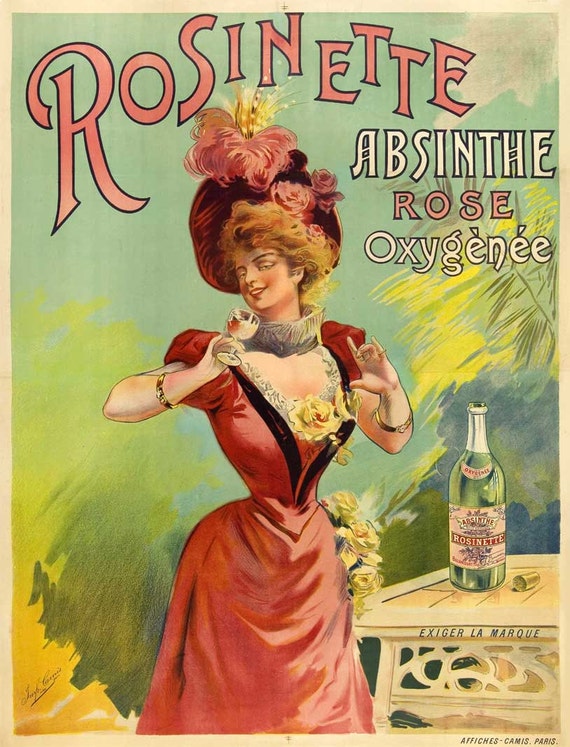
Rosinette Absinthe rose


Artist: unknown

Advertising: Rosinette, Absinthe Rosé Oxygénée

Era: 1890s

An unrecorded lithographic poster for Rosinette, Absinthe Rosé Oxygénée, printed by Camis around 1900. This is the only know historical reference to a rosé absinthe. 
Absinthe is historically described as a distilled, highly alcoholic beverage and is commonly referred to in historical literature as "la fée verte" (the green fairy). Absinthe arose to great popularity as an alcoholic drink in late 19th- and early 20th-century France, particularly among Parisian artists and writers. Owing in part to its association with bohemian culture, the consumption of absinthe was opposed by social conservatives and prohibitionists.

Available here

Leonetto Cappiello : Je ne fume que le Nil

Artist: Leonetto Cappiello

Advertising: Le Nil - cigarette paper company

Era: 1910s

Leonetto Cappiello (1875 – 1942) was an Italian poster art designer who lived in Paris. He is now often called 'the father of modern advertising' because of his innovation in poster design. The early advertising poster was characterized by a painterly quality as evidenced by early poster artists Jules Chéret, Alfred Choubrac and Hugo D'Alesi. Cappiello, like other young artists, worked in way that was almost the opposite of his predecessors. He was the first poster artist to use bold figures popping out of black backgrounds, a startling contrast to the posters early norm.
This poster, created around 1900-1910, is an advertisement for the "papier à cigarettes" (cigarette rolling paper). The elephant is an exotic symbol of Africa and Egypt, the country of the Nil river. Exotic symbols were very used during the colonial times of the Belle Epoque.

Available here

BYRRH Advertisement

I've just found more than 50 Byrrh advertisements by Georges Léonnec ! I do not know if they are famous in the USA but they are in France.
They are already available in my Etsy shop: http://etsy.me/1brmNgc

Byrrh is a wine-based apéritif made of red wine, mistelle, and quinine. Created in 1866, it was popular as a French apéritif. With its marketing and reputation as a "hygienic drink", Byrrh sold well in the early 20th century. In the 1930s, Byrrh had 50% of the "aperitif" market share in France.

BYRRH Factory
The Story:
Brothers Pallade and Simon Violet, itinerant drapers, decided to take advantage of the wine fever in the region to develop an apéritif wine flavored with cinchona. They mixed dry wines and mistelles and initially marketed the resulting product as a health drink or tonic. This was because the local apéritif producers were displeased about competition with their established brands. Rebranding the brothers' aperitif as a health drink got around this problem, and Byrrh was sold in pharmacies.


The Second World War initiated the decline of Byrrh. Aided by tax benefits, natural sweet wines such as Banyuls, Muscat de Frontignan, and Rivesaltes superseded Byrrh, which went out of fashion.

In 1977, the family business, divided by strife, was acquired by Pernod-Ricard. Pernod-Ricard still makes the drink at its facility in Thuir near Perpignan, part of which was designed by Gustave Eiffel.

Advertisements for Byrrh are often visible in older French films or in films set in the France of the past. One example is François Truffaut's Shoot the Piano Player (1960), or the 1970 World War II comedy Kelly's Heroes.

Mad Men Season 4, episode 6 ("Waldorf Stories") featured a Byrhh advertisement that won a CLIO Award in April 1965. AV Club Reviewer Keith Phipps notes: "One of the other Clios went to Byrrh, a wine-based aperitif whose failure to catch fire in America illustrates that even great advertising can’t sell something people don’t want."
BYRRH in Mad Men

The most famous Byrrh advertisements were created by Georges Léonnec.

Georges Léonnec (1881 – 1940), the brother of the novelist Félix Léonnec, began his career as a cartoonist selling drawings to newspapers in 1899. After participating in World War I he worked as an illustrator for the magazine La Vie Parisienne. He worked for several other publications including Fantasio and Le Sourire. He was also well known for his advertising illustrations for Byrrh apéritif wine, Dufayel department stores, and the Casino of Paris.

This is just a few of the ads available in the shop: http://etsy.me/1brmNgc
The ads are true vintage ads from the 30s, not recent reprint !


Paris seen by Hollywood 2 : Midnight in Paris

This is the 2nd post about Paris seen by American movies!
If you love Paris and specially Paris during the Roaring Twenties and the Belle Epoque. You definitively want to see this one !


I do not want to give you too many informations about the movie, because it might spoil you the surprise. But I still want to introduce you some of the characters. (If you don't want to know, do not read! ;) )

In this movie you'll meet several American writers and artists from the 20s, living in Paris at that time:

Zelda and F.Scott Fitzgerald (by Alison Pill and Tom Hiddleston). F.Scott is an American author of novels and short stories, whose works are the paradigmatic writings of the Jazz Age. He is widely regarded as one of the greatest American writers of the 20th century. (by the way, he's the one who wrote "The Great Gatsby"!)


Ernest Hemingway (by Corey Stoll) was an American author and journalist. His economical and understated style had a strong influence on 20th century fiction, while his life of adventure and his public image influenced later generations. Hemingway produced most of his work between the mid-1920s and the mid-1950s, and won the Nobel Prize in Literature in 1954. He published seven novels, six short story collections, and two non-fiction works. His most famous work is "The Old Man and the Sea".
In 1921 he married Hadley Richardson, the first of his four wives. The couple moved to Paris, where he worked as a foreign correspondent, and fell under the influence of the modernist writers and artists of the 1920s "Lost Generation" expatriate community.


Pablo Picasso (by Marcial dy Fonzo Bo) was a Spanish painter, sculptor, printmaker, ceramicist, and
stage designer who spent most of his adult life in France. As one of the greatest and most influential artists of the 20th century, he is widely known for co-founding the Cubist movement, the invention of constructed sculpture, the co-invention of collage, and for the wide variety of styles that he helped develop and explore. Among his most famous works are the proto-Cubist Les Demoiselles d'Avignon (1907), and Guernica (1937), a portrayal of the German bombing of Guernica during the Spanish Civil War.


Salvador Dalí (by Adrien Brody) (his real name is Salvador Domingo Felipe Jacinto Dalí i Domènech, 1st Marqués de Dalí de Pubol (!)). He was a prominent Spanish surrealist painter born in Figueres, in the Catalonia region of Spain. Dalí was a skilled draftsman, best known for the striking and bizarre images in his surrealist work. His painterly skills are often attributed to the influence of Renaissance masters. His best-known work, The Persistence of Memory, was completed in 1931. Dalí's expansive artistic repertoire included film, sculpture, and photography, in collaboration with a range of artists in a variety of media.


Henri de Toulouse-Lautrec (by Vincent Menjou Cortes) and Edgar Degas (by François Rostain).
Henri de Toulouse-Lautrec (1864 – 1901) was a French painter, printmaker, draughtsman, and illustrator, whose immersion in the colourful and theatrical life of Paris in the late 1800s yielded a collection of exciting, elegant and provocative images of the modern and sometimes decadent life of those times. Toulouse-Lautrec is known along with Cézanne, Van Gogh, and Gauguin as one of the greatest painters of the Post-Impressionist period. 
Edgar Degas, born Hilaire-Germain-Edgar De Gas; 19 July 1834 – 27 September 1917) was a French artist famous for his paintings, sculptures, prints, and drawings. He is especially identified with the subject of dance; more than half of his works depict dancers. He is regarded as one of the founders of Impressionism, although he rejected the term, and preferred to be called a realist.